
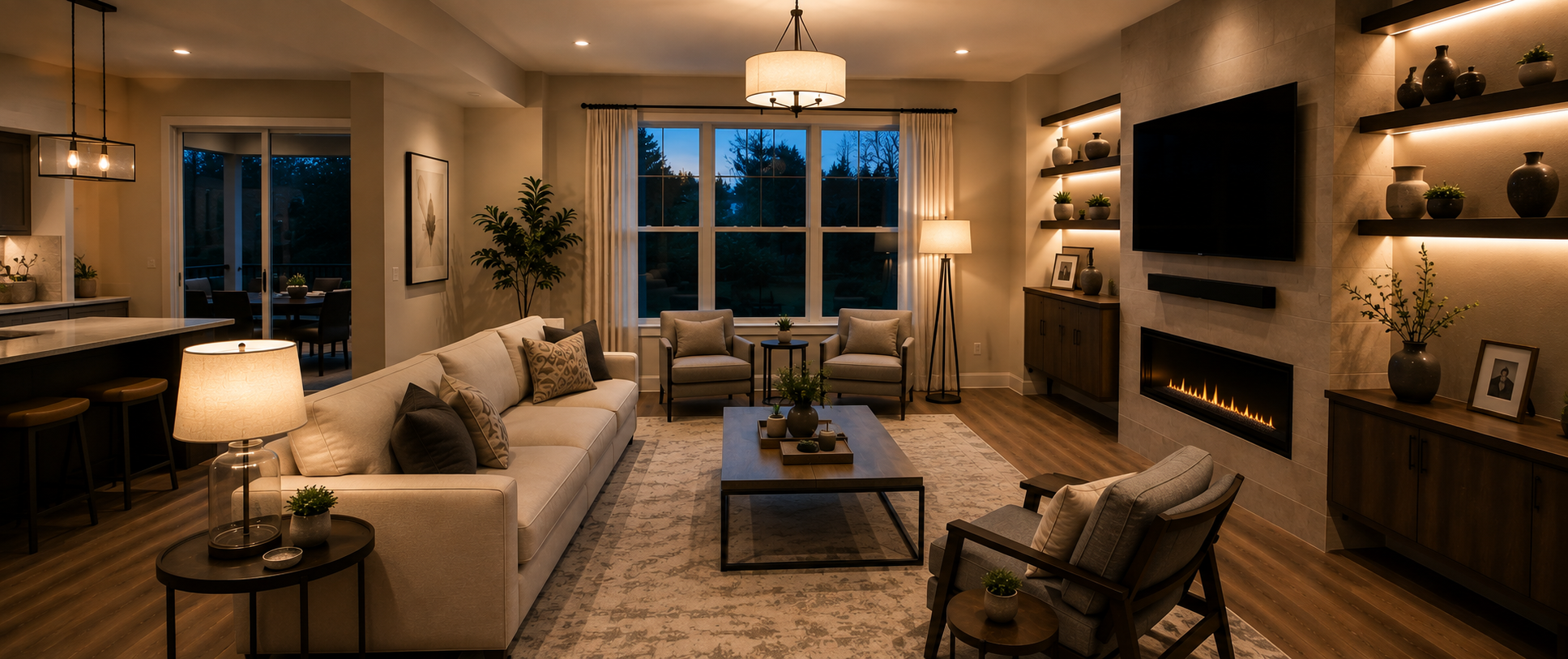
Most people redecorate a living room by changing the sofa, the rug, or the paint color. Then the room still feels flat, and nobody can quite explain why. Nine times out of ten, the problem was never the furniture. It was the lighting.
Good living room lighting Ideas comes from three layers working together: ambient light for overall brightness, task light for reading and activities, and accent light for depth. A living room needs roughly 10 to 20 lumens per square foot spread across at least three separate light sources, all on dimmers. That single principle changes more rooms than any piece of furniture we’ve ever specified
Here’s how to apply it in your own home.
Why Your Living Room Feels Off Even When Every Light Is On
Walk into a room lit by one ceiling fixture and you’ll feel it right away, even if you can’t name it. This is the psychology of interior design at work, light shaping mood before you’ve consciously registered why.
The fix isn’t a brighter bulb. It’s more sources at different heights. A room with light coming from the ceiling, from a table lamp at 24 inches, and from a wall at eye level has real visual depth. Your eye travels through it instead of stopping dead in the middle.
This is far and away the most common issue we walk into on consultations, and it’s usually solvable in an afternoon.
How to Layer Lighting in a Living Room
Layered lighting is the framework every professional designer works from, and it’s simple enough to plan yourself.
Ambient Lighting Comes First
Ambient lighting is the general illumination that lets you move around comfortably. A flush mount, a semi-flush mount, a pendant light, a chandelier, or recessed cans all sit in this category.
Plan this layer before anything else, and be honest about your natural light. A north-facing living room in Allentown loses usable daylight by three in the afternoon in January. A south-facing room won’t need nearly as much artificial light to feel balanced.
Task Lighting Goes Where You Actually Do Things
Task lighting answers a practical question: what happens in this exact spot? A reading chair needs a floor lamp. A seating area where people work on laptops needs a table lamp within arm’s reach. A game table needs its own source.
Position task light so the bulb sits roughly at shoulder height when you’re seated. High enough to light the page, low enough that you’re never staring into the bulb.
Accent Lighting Is What Makes It Look Finished
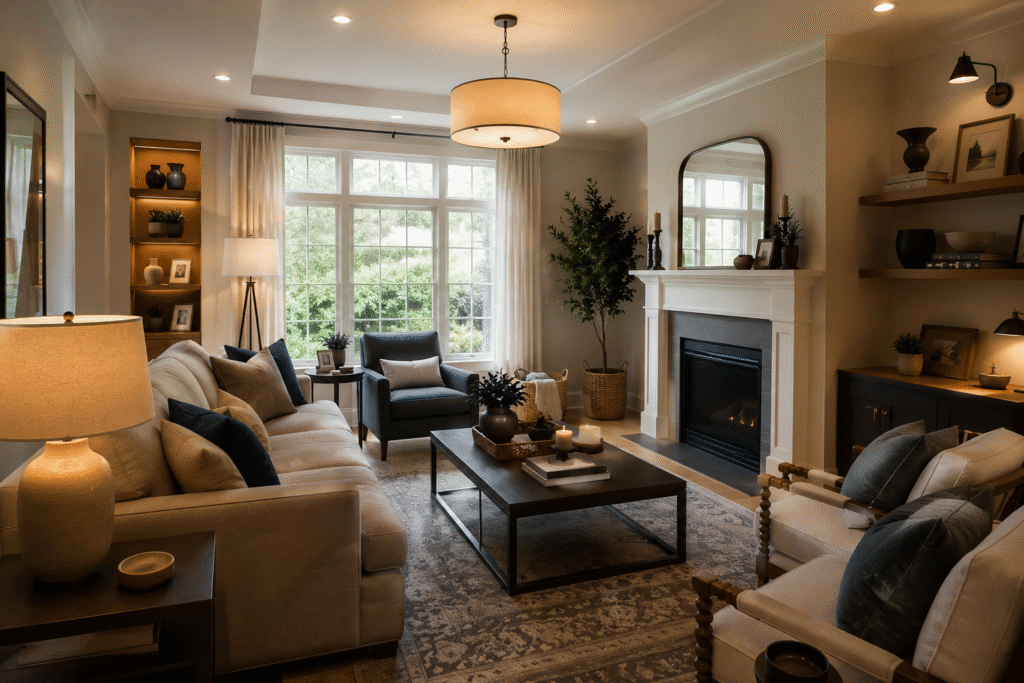
Accent lighting is the difference between a lit room and a designed one. Sconces flanking a fireplace. A picture light over artwork. LED strips washing across built-in shelving. This layer uses the fewest lumens and does the most work visually, because it tells your eye where the focal point is.
How Many Lumens Does a Living Room Need?
Brightness is measured in lumens, not watts. Watts only tell you how much energy a bulb burns.
For a living room, plan on 10 to 20 lumens per square foot for the ambient layer. Multiply length by width, then multiply that by 15 as a sensible middle. A 15 by 20 foot room is 300 square feet, which puts you around 4,500 lumens, spread across several fixtures and never coming from one.
Task areas need more. A reading nook wants closer to 35 lumens per square foot inside that small zone.
One rule we don’t bend: put every source on a dimmer switch. It costs very little during installation and it’s the whole difference between a room that works at 8 a.m. and a room that works at 9 p.m.
A Living Room Lighting Layout That Works in Almost Any Room
Placement matters as much as fixture choice. This living room lighting layout holds up in most spaces:
- Overhead center: one dimmable ambient fixture, sized to the room
- Beside the sofa: a table lamp on an end table or console
- Opposite corner: a floor lamp to pull light into the dead zone
- On the walls: sconces flanking a fireplace, TV, or bookcase
- Inside built-ins: integrated LED for glow at low level
Use odd numbers where you can, and keep sources on separate switches. Three lights on three switches is the working minimum for a room that can genuinely shift mood.
Living Room Lighting Ideas for Homes With No Ceiling Box
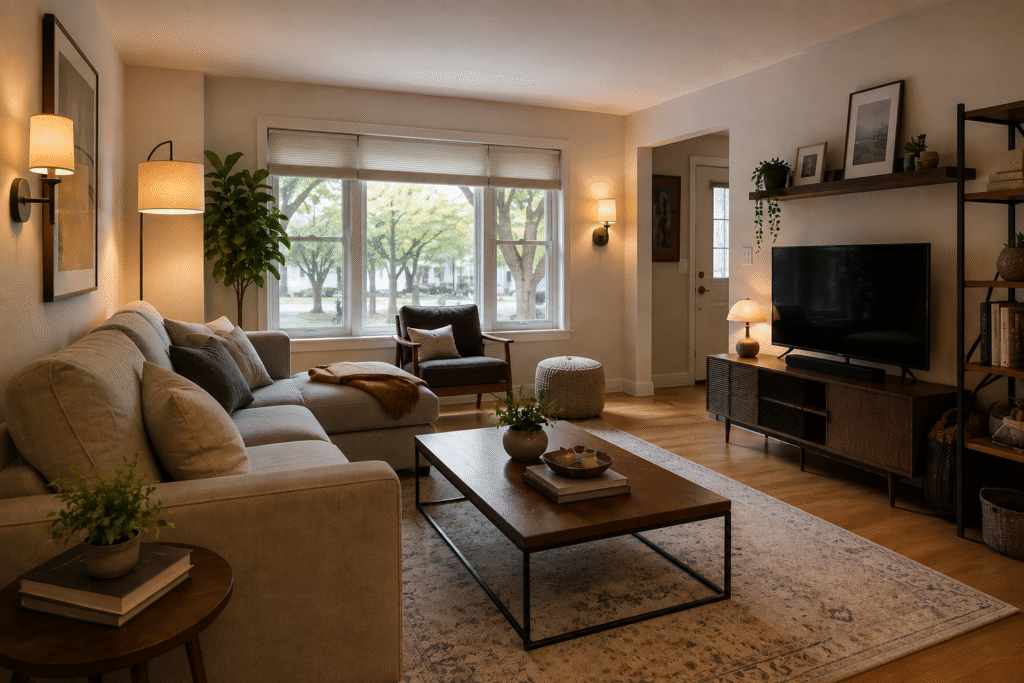
Plenty of older Lehigh Valley homes, and nearly every rental, have living rooms with no overhead wiring at all. You can still build a fully layered room without calling an electrician.
Plug-in wall sconces mount on a bracket and run the cord down behind furniture. A torchiere bounces light off the ceiling and creates ambient light from the floor up, which is the closest thing to an overhead without one. Cordless battery lamps let you light a corner with no outlet nearby. Smart bulbs on a remote give you one-click control of the whole room.
Three well-placed lamps beat one ceiling fixture every single time.
Small Living Room Lighting Ideas That Don’t Eat Your Floor Space
In a small room with an 8-foot ceiling, floor area is the constraint, the same challenge covered in our guide to small living room design more broadly. A flush mount is usually the only sensible overhead option at that height, so let sconces carry the character instead.
The Best Color Temperature for a Living Room
Stay between 2700K and 3000K. That warm white range mimics candlelight and is the foundation of cozy living room lighting. Daylight bulbs at 5000K and above belong in a garage, not a family room. Look for a CRI of 80 or higher so your paint and fabrics look the way they did in the showroom.
Fixtures don’t need to match, but finishes should relate, and the same logic applies to living room colors, warm bulbs read differently against a cool palette than a warm one.
Living Room Lighting Mistakes We Fix Most Often
A few patterns show up again and again, and they sit alongside the broader living room design mistakes we see just as often.
- Relying on one overhead source. The root cause of nearly every flat room.
- Skipping the dimmer. Full brightness is rarely the right brightness.
- Buying a floor lamp that’s too short. Shade bottom should land near eye level when seated.
- Choosing 4000K or cooler bulbs. Technically bright, emotionally cold.
- Lighting the ceiling instead of the room. Recessed grids light the floor and leave the walls dark, which makes a space feel smaller.
Most of these are cheap to correct once you know what you’re looking at.
Bringing It All Together
You don’t need to replace anything to start. Walk into your living room tonight, turn on every light, and count your sources. If the answer is one, you already know what’s wrong. Add a table lamp beside the sofa and a floor lamp in the far corner, swap in warm white bulbs, and see how differently the room reads by the end of the week.
That’s the honest truth about living room lighting ideas: the changes that matter most are usually the least expensive ones in the room. Lighting is also the piece homeowners most often get wrong, and the piece that transforms a space fastest once it’s right.
If you’d rather not guess at fixture sizes, placement, and switching, that’s exactly what a design consultation is for. FFF Interiors works with homeowners across Allentown, Bethlehem, Easton, and the wider Lehigh Valley on living room design, from a single lighting plan to a full room transformation. Get in touch and let’s look at your space.