
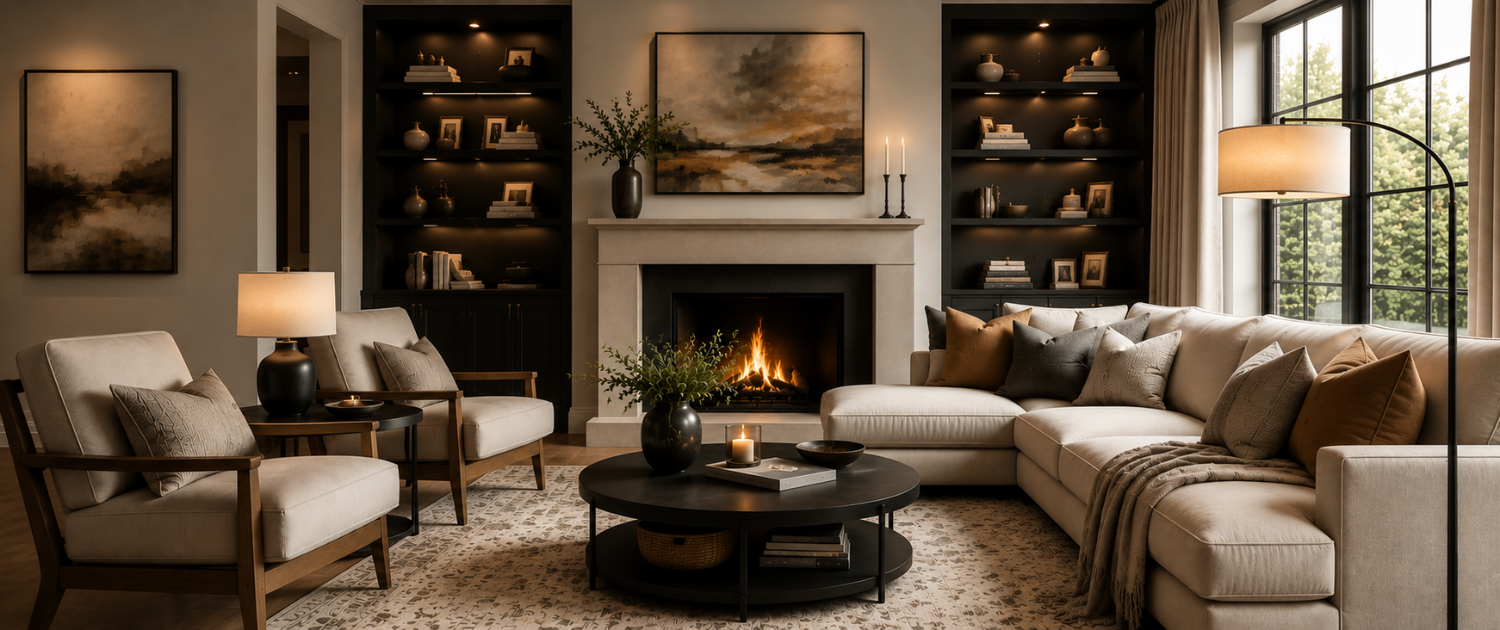
You moved the sofa three times. Bought new cushions. Tried a gallery wall. The room still feels like a furniture showroom nobody actually lives in.
Most homeowners blame their taste or their budget. Neither is the real problem. The living room design mistakes keeping your space from feeling finished are almost always structural, not decorative. And once you know what they are, they are completely fixable.
Common Question Asked
Q: Why does my living room feel incomplete no matter what I add?
Because design problems are structural, not decorative. A room without a focal point, wrong-scale furniture, and flat lighting will feel off regardless of how much you spend. These living room design mistakes are invisible until you know what to look for.
Living rooms that never feel finished are almost always missing the same three or four foundational things. Fix those first, and everything else clicks into place without spending a dollar.
That is worth understanding before you buy another throw pillow.
Your Room Is Missing a Focal Point
Walk into any room that feels immediately “done” and your eye lands somewhere specific within two seconds. A fireplace. A large piece of art. A window with a view. That is the focal point, and it is the invisible anchor the entire room is organized around.
Most unfinished living rooms have no anchor at all, or worse, two competing ones. A television on one wall, a fireplace on the opposite. The eye bounces between them and never settles. The room feels restless even when it is spotless.
How to Fix It
The fix does not require buying anything. Pick one wall as the primary focus and point the seating toward it. If you are also considering a full colour refresh alongside the layout change, the living room colors guide for Lehigh Valley homes covers what is working in 2026 without the guesswork.
If the TV and fireplace are fighting, choose a winner. Everything else becomes the supporting cast. This fix costs nothing and changes how the entire room reads.
The Furniture Is the Wrong Size for the Room
Here is a scenario that happens constantly. A homeowner brings home an oversized sectional and the living room immediately feels smaller than it did empty. Or the opposite: a large open room with a small loveseat floating in the middle that no rug or side table can save.
This is one of the most damaging living room layout mistakes because it cannot be styled away.
How to Fix It
The sofa should fill roughly two-thirds of the wall it faces. The coffee table should be about two-thirds the length of the sofa and sit 14 to 18 inches away from it. These ratios give the room a visual logic the brain registers as “finished” even before noticing the details.
One Light Source Is Killing the Whole Room
This is one of the most common interior design mistakes and the least obvious one. A single overhead ceiling fixture lights the room evenly, eliminates all shadow, and makes even well-decorated spaces feel institutional.
How to Fix It
Layer three sources at different heights: ambient light from above, a floor or table lamp at seated eye level near the reading chair or sofa, and one accent light pointing at something specific like a bookshelf or piece of art. That combination creates depth and warmth no ceiling fixture can replicate. If the room has only one overhead light right now, a single floor lamp is the best money spent on that space in years.
Living Room Design Mistakes: Quick Diagnosis Guide
Use this to identify exactly what your room is missing before changing anything.
| Design Mistake | Why It Happens | Quick Fix |
| Room feels restless with no clear focus | Two focal points competing, or none at all | Pick one anchor wall and orient all seating toward it |
| Room feels smaller after adding furniture | Oversized pieces relative to room dimensions | Sofa should be two-thirds the length of the wall it faces |
| Space looks flat and unwelcoming after dark | Single overhead light source only | Add a floor lamp and one accent light at different heights |
| Rug looks like it belongs in another room | Rug sized for the coffee table, not the seating | Front legs of all seating pieces must sit on the rug |
| Room looks cluttered despite minimal decor | Accessories share no color, material, or finish | Choose one repeating material and let it thread through the room |
| Layout feels awkward but cause is unclear | Furniture pushed against every wall | Float seating inward, leave 12 to 18 inches from walls |
The Accessories Have Nothing in Common
Here is the honest version of what most design advice skips. A room full of beautiful individual pieces can still look like a storage unit if those pieces share no visual language.
Cohesion is not about matching. It is about repetition. One color appearing at least three times. One material, maybe natural wood or matte black, running through several pieces. A consistent finish on frames, hardware, and lighting. These threads do not need to be obvious. They just need to exist.
How to Fix It
Clear a surface completely, then only return what earns its place. Group objects in odd numbers. Vary height within each grouping. Edit ruthlessly. Homeowners drawn to this kind of intentional simplicity often find warm minimalism gives them the clearest framework for making those decisions.
When Styling Is Not the Problem
Sometimes the room has been rearranged, redecorated, and re-accessorized and it still does not work. That usually means the issue is structural. Traffic paths blocked by furniture. Seating positioned too far apart for any real conversation. A layout that made sense in a floor plan but does not work in real life.
When to Bring In a Professional
This is where homeowners in Allentown reach out for a professional eye. Not because the room is beyond saving, but because the problem is genuinely hard to see from inside the space you live in every day. A single walkthrough changes the diagnosis completely. What felt like a taste problem turns out to be a proportion problem. FFF Interiors works through exactly this process; their living room design services include layout analysis as the first step before any styling decisions are made.
Conclusion
Most living rooms do not need more. They need structure. A clear anchor, the right scale, layered light, and accessories that speak the same visual language. Get those four things right and the room stops feeling like a work in progress. If you have been going in circles with the same space, a fresh set of eyes is worth more than another trip to the furniture store.