Most homeowners know what they want their home to feel like long before they know what to call it.
Warm but not heavy. Clean but not cold. Current without chasing every trend that cycles through social media. Comfortable enough for everyday life, polished enough to feel considered.
If that description sounds familiar, there is a good chance the design style you are looking for is transitional interior design. It is one of the most searched and most requested styles in residential design right now, and for good reason. It solves a problem that most other styles do not: it refuses to make you choose between comfort and elegance.
What Is Transitional Interior Design Style?
Transitional interior design is a style that bridges traditional and contemporary design, combining the warmth and comfort of classic interiors with the clean lines and edited aesthetic of modern spaces.
It does not commit fully to either direction. Instead, it takes the best qualities of both and finds a balance that feels neither dated nor cold. The result is a home that is timeless by nature, personal by design, and livable in every sense.
Transitional style is the middle ground between traditional and contemporary design. It uses warm tones, clean lines, quality materials, and a restrained approach to decoration to create spaces that feel both comfortable and current. It is the most widely requested home interior design style in the United States and particularly well suited to Lehigh Valley homes.
Why Transitional Design Works So Well Right Now
In the context of interior design trends 2026, the rise of transitional style makes complete sense. Homeowners have moved away from the strict minimalism of the previous decade and the heavily ornamented traditional interiors of the decade before that. Neither extreme feels right for how people actually live today.
Transitional design sits at exactly the right point between those two directions. It offers:
- Longevity. Because it does not commit to a single trend, transitional interiors do not date the way more specific styles can.
- Flexibility. The style can absorb change over time. A new sofa, a different rug, updated accessories can all refresh a transitional interior without requiring a full redesign.
- Broad livability. It works for families, for professionals, for empty nesters, and for anyone in between because it prioritizes comfort alongside aesthetics.
- Compatibility with existing architecture. In homes with traditional bones such as crown molding, built-in shelving, or classic window proportions, transitional design works with those features rather than against them.
That last point matters significantly for Lehigh Valley homes, many of which carry genuine architectural character from earlier periods. Transitional design does not ask you to erase that history. It asks you to update it thoughtfully.
The Core Characteristics of Transitional Style
Understanding what defines this style in practice makes it easier to apply. Transitional interior design decorating styles are built around a consistent set of principles that hold across every room type.
Neutral Palettes with Warm Undertones
The color foundation of a transitional interior is almost always a warm neutral: soft white with a cream undertone, warm greige, light taupe, or gentle gray with warm rather than cool bias. These tones create a calm backdrop that allows furniture and materials to lead without competing with the wall color.
Deeper accent tones can be introduced through upholstery, rugs, or a single painted wall, but the overall palette stays controlled. There are no high-contrast color moments in a well-executed transitional interior.
Clean Lines with Comfortable Proportions
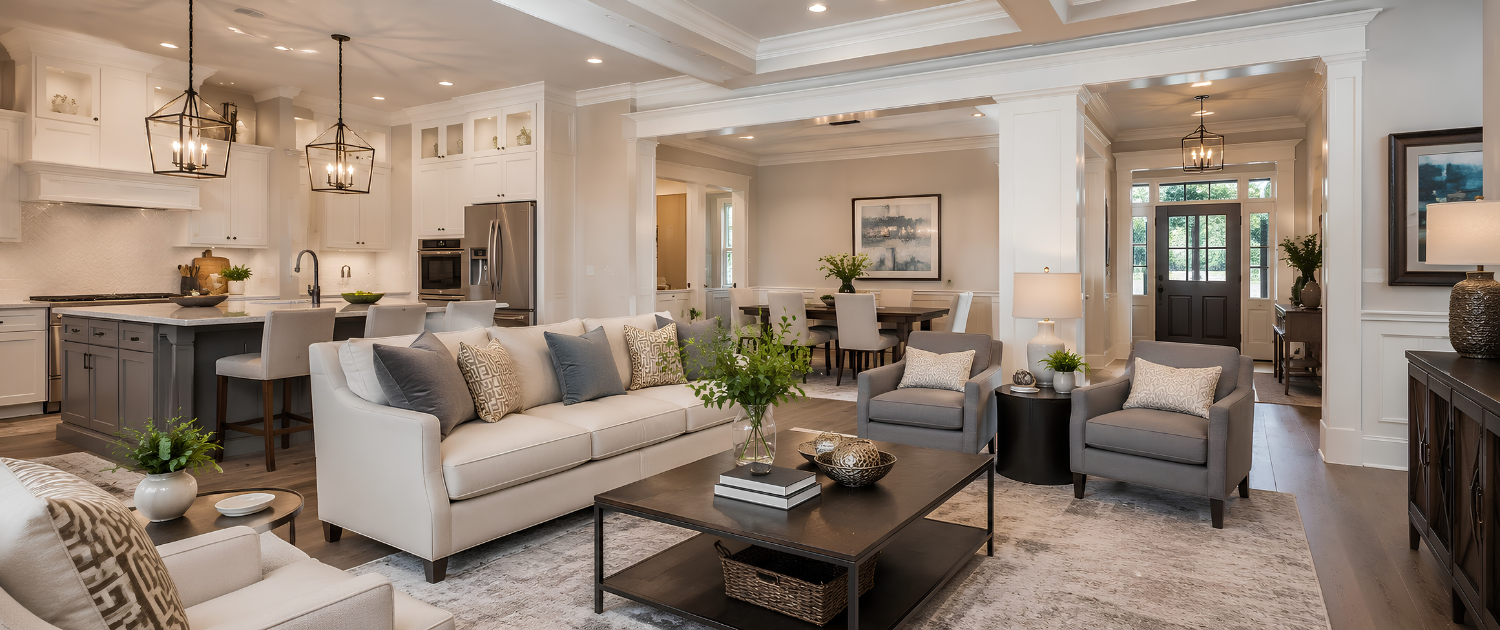
Transitional furniture sits between the ornate curves of traditional design and the sharp geometry of contemporary design. Sofas have simple, straight profiles but are generously scaled for comfort. Dining chairs have clean backs without excessive carving but are upholstered for ease. Coffee tables are understated in form but substantial in scale.
The goal is furniture that reads as current without feeling designed primarily for appearance.
Quality Materials Over Decorative Detail
Where traditional design relies on decorative detail, transitional design relies on material quality. The interest in a transitional room comes from the texture of a linen sofa, the grain of a solid oak coffee table, the finish of a brushed nickel fixture, and the weight of a wool area rug.
This is one reason transitional interiors photograph well and live well simultaneously. There is nothing fussy to clean or maintain. The quality is in the material itself.
Restrained Use of Pattern
Pattern in a transitional interior is used with discipline. A geometric rug in a neutral colorway, subtle texture in an upholstery fabric, a simple stripe on a throw pillow. Pattern never dominates. It contributes to the texture conversation without drawing attention to itself.
Layered Lighting
Transitional interiors use lighting thoughtfully and in layers. A simple but well-proportioned chandelier or pendant provides ambient light. Table and floor lamps add warmth at a lower level. Recessed or directional lighting can accent architectural features or artwork. The layering creates depth and atmosphere that a single overhead fixture cannot produce.
How to Apply Transitional Design Room by Room
Living Room
Anchor the room with a neutral sofa in a performance fabric, linen, or velvet in a warm tone. Add one upholstered accent chair in a complementary tone or subtle pattern. Use a wool area rug with a simple geometric or organic pattern to define the seating zone. Choose a coffee table in natural wood or a warm metal finish. Layer lighting with a floor lamp and at least one table lamp alongside the ceiling fixture.
For Lehigh Valley homes with original wood floors or built-in shelving, let those features anchor the room and choose furniture that relates to their scale rather than competing.
Bedroom
The transitional bedroom prioritizes calm. A upholstered bed frame in a neutral tone, quality bedding in layered whites and warm creams, and nightstands in a simple wood or painted finish create the foundation. Window treatments should provide light control without heavy fabric. A single piece of considered artwork above the bed replaces a gallery wall.
Working with an interior designer Allentown PA homeowners trust can help translate these principles into specific product choices that match the proportions and light conditions of the actual room.
Kitchen
Transitional kitchens use painted cabinetry in a warm neutral or a sophisticated deeper tone such as soft navy or sage green. Hardware is simple: brushed nickel, unlacquered brass, or matte black in clean, minimal profiles. Countertops are typically stone in a natural finish. Upper cabinetry is reduced or replaced with open shelving in some zones to lighten the space.
Hallway and Entry
The entry sets the tone for the entire home. In a transitional interior, this means a simple console in natural wood or a clean-lined painted finish, a substantial mirror above it, one considered light fixture, and a rug that introduces warmth underfoot. Nothing excessive. Nothing missing.
For complete room-by-room guidance on interior design styles and how they apply to Lehigh Valley homes, the Complete Interior Design Style Guide for Lehigh Valley Homes covers every major decision in one place.
Transitional Design vs. Other Interior Design Styles
Homeowners often come to transitional design after exploring other directions. Understanding where it sits relative to other interior design decorating styles makes the choice clearer.
| Style | Character | Best For |
| Traditional | Ornate, layered, historically referenced | Homes with strong classical architecture |
| Contemporary | Current, flexible, reflects today’s moment | Newer construction, design-forward homeowners |
| Transitional | Balanced, warm, timeless | Most existing homes, most homeowners |
| Modern | Strict, geometric, minimal ornamentation | Specific architectural contexts |
| Japandi | Restrained, craft-focused, calm | Homeowners wanting maximum simplicity |
| Eclectic | Curated, personal, mixed periods | Homeowners with strong individual vision |
Transitional sits in the center of this spectrum deliberately. It is the most versatile of all home interior design styles because it works within the broadest range of architectural contexts and life stages.
For a broader look at how these styles relate to each other and how to choose between them, the eclectic interior design guide and the warm minimalism guide on the FFF Interiors blog offer useful contrast perspectives.
Conclusion:
Transitional interior design is not a compromise. It is a considered choice.
It works because it is built around how people actually live, not around how a space photographs. The warmth is real. The comfort is intentional. The clean lines are there to create calm, not to perform a style.
For Lehigh Valley homeowners with homes that carry architectural character, a mix of furniture they love, and a preference for spaces that hold up over time, transitional design is rarely the wrong answer. It grows with you, absorbs change gracefully, and never asks you to choose between a home that looks good and one that feels good.
If you are ready to explore what this style looks like in your specific home, the Designer for a Day consultation at $99 is the simplest starting point. Two hours, your space, a clear design direction.