If you are planning a remodel and trying to choose between a broken floor plan and an open concept layout, you are not alone. This is one of the most common decisions homeowners face before starting a renovation, and most get it wrong by basing it on what photographs well rather than what actually works for daily life.
Here is the honest answer on both layouts, what each delivers, where each fails, and how to decide which direction makes sense for your home.
Common Question Asked
Q: What is the difference between a broken floor plan and an open concept layout?
An open concept layout removes walls entirely to create one large connected living space. A broken floor plan keeps spaces connected but uses partial walls, built-ins, level changes, or architectural details to define distinct zones. It delivers the flow of open concept with the function and privacy of defined rooms.
A broken floor plan is not the opposite of open concept. It sits between a fully open layout and a traditionally closed one. It maintains visual connection between areas like the kitchen, dining room, and living room while preserving enough separation for noise control, privacy, and purpose. For most Lehigh Valley homes, it solves what a fully open layout cannot.
What Open Concept Gets Right
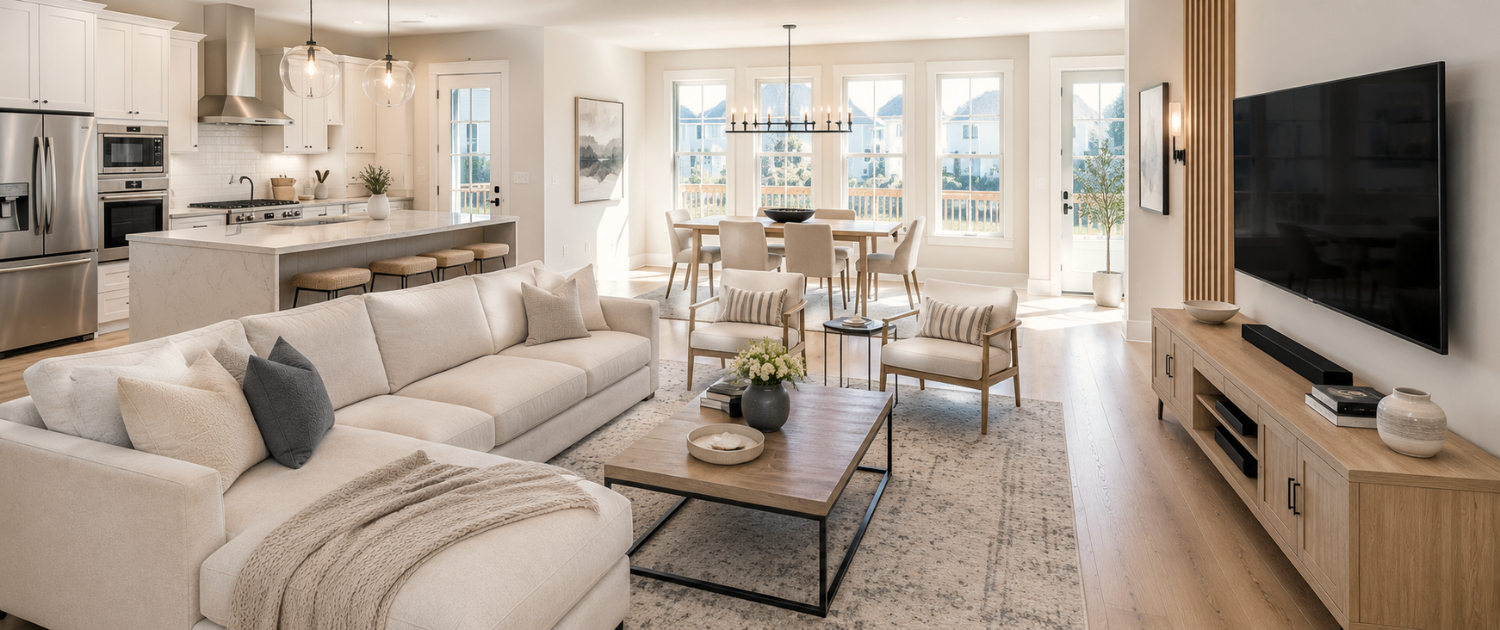
Open concept layouts dominated American homes for a reason. Removing walls between the kitchen, dining, and living areas creates a genuine sense of space. Natural light travels further, sightlines open up, and the home feels larger than its square footage suggests.
For entertaining, it works well. Guests move freely, the host stays connected to conversation, and the entire main floor operates as one flowing social space.
Where Open Concept Falls Short
The problems with a fully open layout only become obvious once you are living in one.
Noise is the most immediate issue. Sound from the kitchen, television, and conversation all compete in the same space with nothing to absorb or redirect it. A family trying to watch a film while someone cooks in the same area quickly understands why walls exist.
Privacy disappears entirely. There is no defined space to work, study, or sit quietly without being in the middle of household activity. As more people work and spend extended time at home, rooms that provide privacy while still offering good flow are becoming far more desirable than layouts that limit flexibility.
Cooking smells travel to every corner. Clutter in one area is visible from everywhere. Heating and cooling costs rise because there are no interior zones to manage temperature independently.
What a Broken Floor Plan Actually Delivers
A broken concept design encourages connection between spaces like the kitchen and living room, without the common downsides of open plans such as noise, clutter, or lack of privacy.
Instead of doors and full walls, this layout uses thoughtful design elements to create distinction between areas. Half walls, built-in shelving, ceiling height changes, floor level transitions, archways, and strategic furniture placement all define zones without closing them off. Internal windows and subtle ceiling or trim details let each area feel unique while the overall layout remains connected and cohesive.
The result is a home where the kitchen, dining area, and living room remain visually connected but each carries its own identity, purpose, and acoustic boundary.
Which Layout Works Better for Lehigh Valley Homes
Most homes across Allentown, Bethlehem, and Easton are older builds. Colonials, split-levels, and ranchers with existing structural walls and defined room configurations are the norm here. These homes were not designed for full open concept layouts, and forcing that approach often means expensive structural work and results that fight the original architecture rather than work with it.
For families spending significant time indoors, having some separation makes a home feel more comfortable and functional rather than simply more spacious. A broken floor plan works with the existing bones of a Pennsylvania home, which reduces remodel complexity, cost, and the risk of a result that still does not feel right.
For newer builds or larger homes where the primary goal is visual space and entertaining, open concept can still make sense. The right choice depends entirely on how your household actually uses the space.
How to Know Which One Is Right for Your Home
The most useful question before choosing a layout is not which one looks better. It is what is specifically not working in your current space.
If your home feels dark, disconnected, and too closed off, opening walls up may be the right move. If it feels noisy or like every activity bleeds into the next, defined zoning addresses that directly.
At FFF Interiors, this conversation always starts with how the household actually moves through the home during a regular day. That single question shapes every layout decision more accurately than any trend ever could.
Conclusion
Neither layout is the right answer for every home. Open concept delivers space, light, and connection. A broken floor plan delivers function, privacy, and daily livability that feels better to live with even if it photographs less dramatically. For most homeowners in the Lehigh Valley area, understanding that difference before a single wall comes down is worth the conversation. If you are unsure which direction suits your home, a design consultation is the clearest place to start.