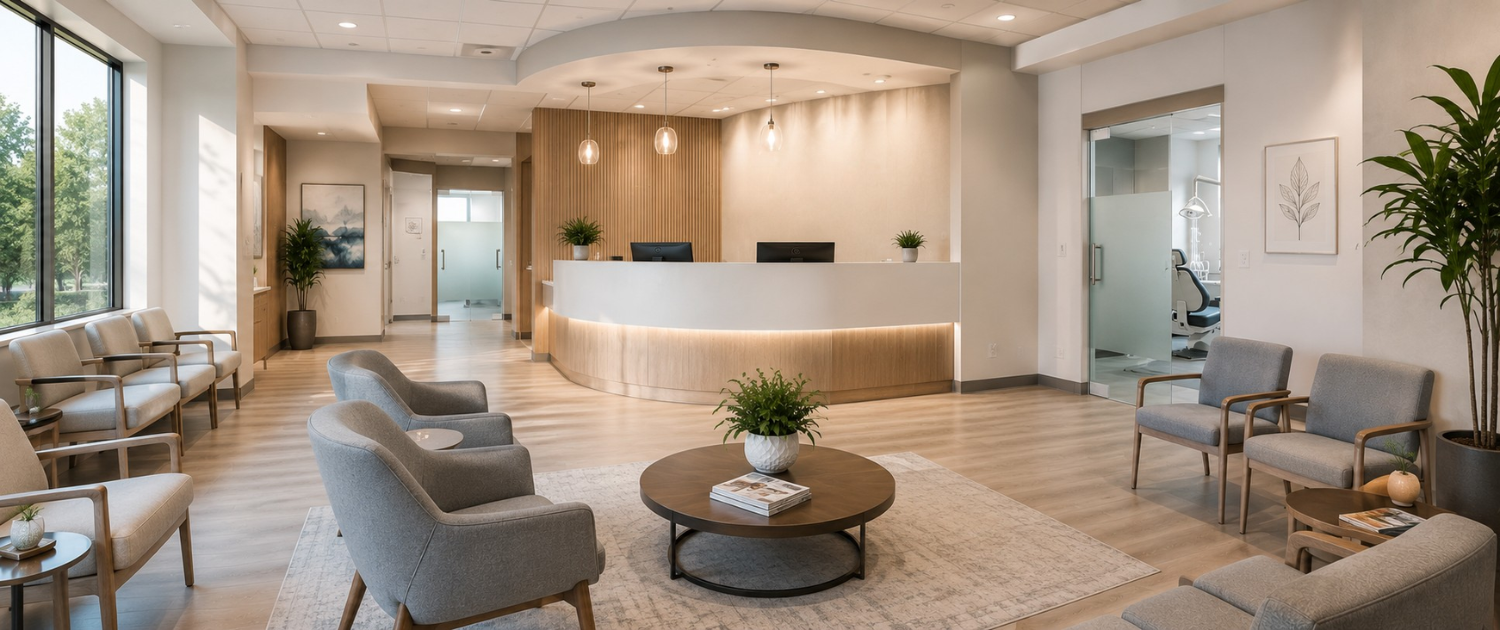
Dental office interior design shapes how patients feel from the moment they step inside. A welcoming reception area, balanced lighting, and a practical layout can ease anxiety before treatment begins, while still letting the practice run efficiently through a full day.
Every practice has different goals and workflows, so there is no one-size-fits-all solution. At FFF Interiors, we believe successful healthcare spaces balance function with comfort: interiors that support staff and reassure patients.
What Makes Dental Office Interior Design Feel Calming Instead of Clinical?
Dental office interior design feels calming when lighting, acoustics, materials, and layout work together to reduce patient anxiety while still meeting clinical and cleanability standards.
The goal is not to hide that a space is medical. It is to stop that fact from dominating a patient’s first impression.
Lighting Design Does More Work Than Most Practices Realize
Lighting is the most underestimated decision in a dental office. A row of uniform fluorescent panels reads as institutional before a patient has processed anything else in the room. The answer is to change the light by zone rather than running one specification across the whole floor plate.
- Reception and waiting: warmer ambient light around 2700K to 3000K, closer to hospitality than healthcare
- Corridors: a neutral 3500K to bridge the warm and clinical zones
- Operatories: high-output task lighting near 5000K with a high colour rendering index, so shade matching stays accurate
A clinician needs precision exactly where they are working. A patient needs calm everywhere their eyes rest: the ceiling, the wall beside the chair, the doorway they walked through.
Acoustics: The Comfort Layer Most Practices Forget
Sound is the most overlooked part of dental office design, and often the most anxiety-inducing. Handpiece noise carrying from an operatory into the waiting room undoes more good than any visual choice can repair. There is a compliance side too, since conversations at reception need enough privacy to satisfy HIPAA expectations.
The usual measures are acoustic ceiling tiles with a higher noise reduction rating, insulation carried up through operatory partitions, sound-absorbing panels in corridors, and low-level sound masking at the front desk.
Material Choices That Read as Warm, Not Sterile
Every dental interior has to meet durability, infection-control, and cleanability standards. That part is non-negotiable. The mistake is assuming it means every surface must look clinical.
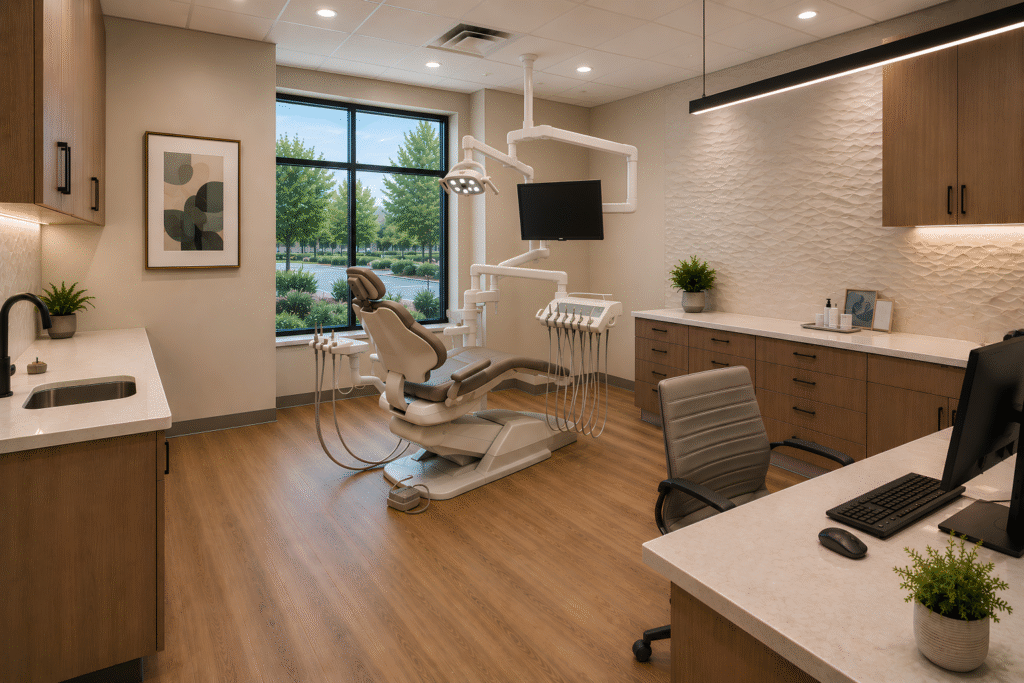
Luxury vinyl tile in warm wood tones, textured but wipeable wall finishes, seamless solid surface countertops, and softer colour palettes all meet the same requirements. They just produce a relaxing room instead of a hospital corridor.
Layout and Space Planning Come Before Aesthetics
Finishes cannot fix a floor plan. Space planning is where a dental project either works or quietly costs the practice time every single day.
Operatory Sizing and Sightlines
Most dental layouts plan for roughly 300 to 400 square feet per operatory once the chair, delivery system, cabinetry, and circulation are accounted for. Operatory count drives almost every other number in the project, so it should be settled first.
Inside the room, orient the chair so the patient’s resting sightline lands on a window, a soft accent wall, or a ceiling feature rather than an instrument tray.
Sterilization and Staff Flow
A sterilization area needs a one-directional workflow, moving instruments from contaminated intake to clean storage without doubling back. Placing it centrally, with short and roughly equal walking distances to every operatory, removes a surprising amount of daily friction for the clinical team.
Reception and Waiting Room Design
The waiting room does more emotional work than any other space in the practice. Patients sit with their own thoughts here, often anxious ones, before they have spoken to a single member of staff.
Seating and Layout
Arrange seating in smaller groupings rather than one long row facing the same direction. Add a quieter corner for patients who would rather not sit in the open, and keep sightlines clear so nobody is left wondering where to go next.
The Reception Desk
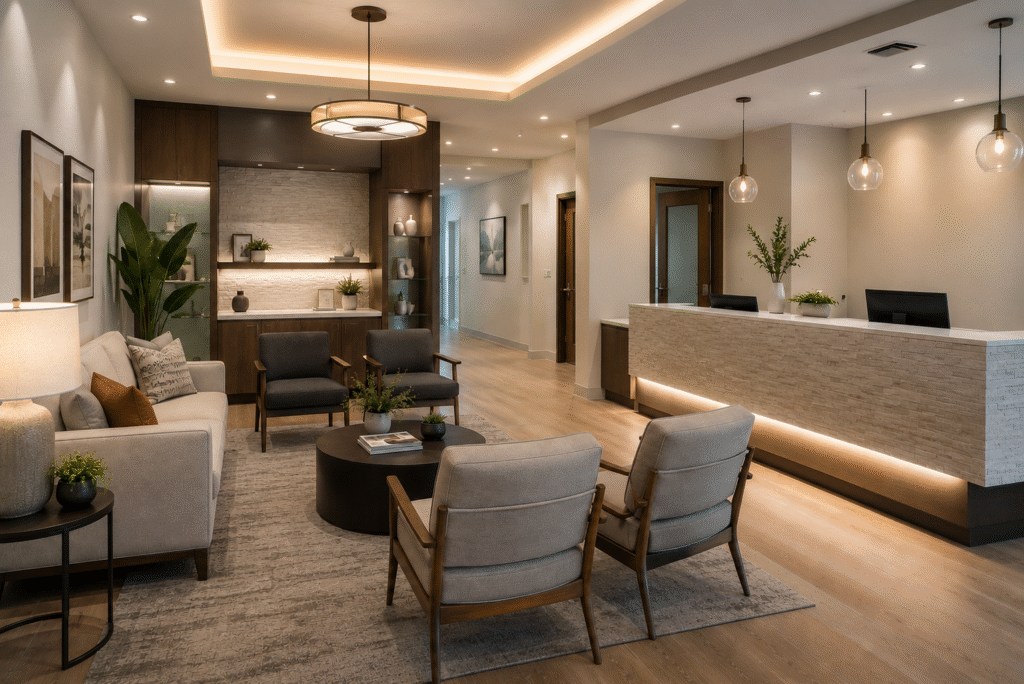
A low, open desk reads as approachable. A tall counter reads as a barrier. Keep monitors screened from the patient side, and treat the front desk as an acoustic priority rather than just a furniture decision.
Dental Office Design Trends Worth Considering in 2026
| Design Element | The Trend Direction in 2026 |
| Colour palette | Moving away from stark white toward sage greens, warm neutrals, and earthy tones |
| Lighting | Layered and zoned rather than uniform overhead panels |
| Acoustics | Treated as a design layer, not an afterthought |
| Reception desk | Low and open instead of tall and separating |
| Seating layout | Smaller grouped clusters instead of a single row facing forward |
| Flooring | Warm-toned wood-look luxury vinyl replacing cold, reflective surfaces |
| Wall finishes | Textured and tactile rather than flat clinical surfaces |
| Overall direction | Hospitality-inspired spaces replacing the traditional sterile look |
Working With a Healthcare-Focused Design Firm
Good dental office interior design only works when the designer understands the patient’s emotional experience and the operational reality of the practice. Not making a space look attractive in photographs, but making it work on a Tuesday morning with a full schedule and an anxious patient in chair two.
At FFF Interiors, we approach healthcare and dental projects by starting with how the space has to function for staff and patients, then building the calming environment around that foundation.
If you are weighing up a renovation, a relocation, or a first build-out, the easiest place to start is a conversation about the space itself. Our $99 Commercial Design Consultation is set up for that: a focused session to review your layout, priorities, and budget before any drawings begin.
Conclusion
Dental office interior design sits at an unusual intersection. Strict clinical requirements on one side, and a patient’s anxiety about being there at all on the other. Lighting, acoustics, materials, and layout are not separate from patient care. They are part of it, and good design treats them that way from the first sketch.